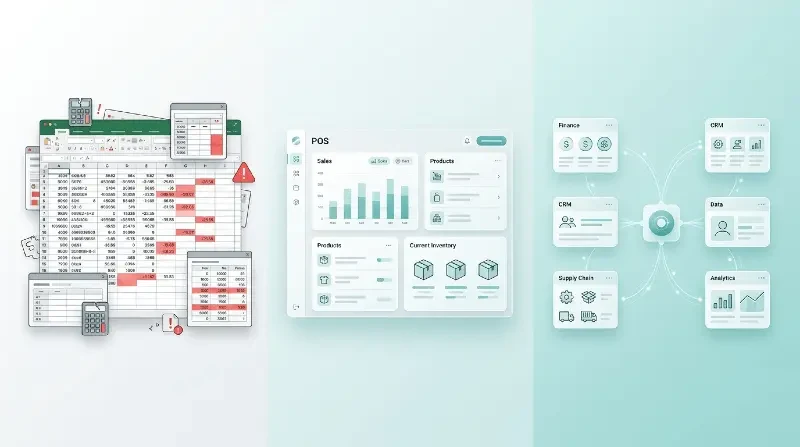
Digital Transformation for SMEs: Where to Start
SME digital transformation playbook: prioritize high-cost processes, prove ROI, and scale change management—technology as a business lever, not an IT project.
Digital transformation fails when it starts with software shopping instead of process economics. SMEs win by digitizing the workflow that burns the most labor or cash first, measuring impact for 30-60 days, then expanding with executive sponsorship—this guide gives a pragmatic starting sequence.
Digital Transformation Is Not a Technology Project
The biggest mistake SMEs make is treating digital transformation as an IT initiative. It's a business strategy initiative that uses technology as a lever. The goal isn't to 'go digital' — it's to serve customers faster, reduce operational costs, make better decisions with data, and scale without proportionally increasing headcount.
The Practical Starting Point
Start with the process that costs you the most time or money. For a distribution company, that's usually order collection and route management. For a retailer, it's inventory reconciliation. For a restaurant, it's customer acquisition costs. Digitize that one process first, prove the ROI, then expand. This approach gets buy-in from stakeholders because they see results before you ask for the next investment.
We've guided dozens of SMEs through this journey. The ones who succeed are the ones who start small, measure everything, and scale based on evidence — not enthusiasm.
MENA operators, digital transformation roadmaps for SMEs in MENA, and realistic digital roadmaps
E-commerce development and marketplace platforms both demand strong identity, payments, and dispute workflows; the difference is whether you own the entire catalog economics or orchestrate third-party merchants. Either way, system integration with tax and invoicing rules in your markets prevents painful retrofits later.
If you are comparing vendors across MENA, look for a software development company that can combine Odoo ERP implementation, mobile app development, and AI automation when your roadmap needs all three. The strongest outcomes pair a pragmatic ERP core with API-first system integration so dashboards and customer apps read the same stock and ledger truth.
FAQ-style checkpoints teams use before buying software
Do you need ERP implementation now, or better POS integration and inventory discipline first? Do mobile app requirements include offline capture for field teams? Will AI automation connect to audited sources, or only to public text? Answering these honestly keeps budgets aligned with outcomes.
Budgets, procurement, and compliance when scaling digital transformation roadmaps for SMEs in MENA
Procurement teams in Saudi Arabia and Qatar frequently require SOC-oriented documentation, while Lebanese and Iraqi operators often prioritize cash-flow-friendly phasing and FX-aware invoicing. Regardless of geography, separate capital budgets for licenses from operating budgets for change management and training—underestimating training is the fastest way to stall Odoo ERP or mobile app adoption.
When evaluating a software development company, ask for reference architectures showing ERP implementation boundaries, how APIs are versioned, and how production incidents are handled. Strong partners document integration contracts, back-pressure behavior on queues, and rollback plans—signals that matter more than slide decks for serious digital transformation programs.
Industry snapshots: retail, FMCG, logistics, and healthcare
Retail chains often start with POS integration and loyalty, then widen to Odoo ERP when inter-store transfers and promotional pricing need a single engine. FMCG distributors in Iraq and the Levant prioritize van sales accuracy, proof-of-delivery, and rebate tracking tied to ERP stock—because every route variance shows up in cash. Logistics operators need mobile app development that tolerates offline capture, while healthcare clinics balance appointment apps with strict access logs and audit trails.
Across these sectors, business intelligence dashboards only help when definitions match how finance closes the month. Tie dashboard refreshes to ERP cutoffs, name metric owners in writing, and review exceptions weekly—otherwise “digital transformation” becomes a slogan instead of measurable working capital improvements.
Finally, align your internal linking discipline the same way you align inventory: every major workflow should have a named system of record, a backup source, and an integration test that runs after each ERP or POS upgrade. That habit is what lets teams in Lebanon, Qatar, Saudi Arabia, and Iraq keep shipping features without freezing operations whenever a vendor ships a breaking API change.
Key takeaways before you brief a delivery partner
Treat digital transformation roadmaps for SMEs in MENA as a portfolio decision: stabilize POS and ERP foundations, then customer-facing mobile experiences, then AI automation where data quality and governance can support it. Demand written acceptance tests for integrations, insist on bilingual enablement when your teams operate in Arabic and English, and keep one executive sponsor so trade-offs do not reset every sprint.
Conclusion: prioritize integrations, then scale intelligence
Whether your next step is Odoo ERP, a customer-facing mobile app, or AI automation, sequence the work so each release removes manual reconciliation. Weave Wider supports Lebanon and GCC rollouts with bilingual workshops, documentation, and handover packages when your IT team wants ownership. Book a consultation to translate this article into a scoped plan with timelines and integration risks spelled out upfront.